
Pop-up canopies are a familiar sight at Australian outdoor markets, sporting events, campgrounds, trade shows and backyard gatherings. For importers, wholesalers and outdoor retailers in Australia, sourcing the right canopy involves looking beyond price and dimensions.
Venue requirements, anchoring methods, fabric performance and frame construction all influence whether a product is suitable for its intended application. A canopy that works well in a backyard may not meet the requirements of a public event or a council-managed space.
This guide covers the key considerations when sourcing pop-up canopies for the Australian market, from local site requirements and material selection to OEM customisation and supplier evaluation.
1. Understand Local Site Requirements Before Choosing a Canopy
There is no single national anchoring rule covering every temporary canopy in Australia. Requirements vary between councils, public spaces, private venues and event organisers.
Take the City of Boroondara in Victoria as one example. Small temporary structures such as marquees are permitted in certain parks and gardens. At locations where they are allowed, they must be secured with sandbags or water weights. Ground pegs and stakes are not permitted at these locations, and the structures must be removed after the event.
The City of Whitehorse in Victoria provides another useful reference in its 2025 Event Planning Fact Sheets. For marquees and gazebos without a stated wind rating, its guidance specifies minimum ballast weights of 20kg per leg for structures without walls and 40kg per leg for structures with walls. Acceptable options include sandbags, steel leg weights, concrete weights and water ballast.
These are local event requirements, not nationwide rules. Buyers should always confirm the specific venue or council guidelines before choosing a canopy and its anchoring accessories.
What should buyers check?
Whether ground pegs or stakes are permitted at the location
Whether ballast weights are required, and which types are accepted
Whether the venue sets minimum weights for each canopy leg
Whether larger temporary structures need additional approval
Whether the canopy can be safely installed, monitored and dismantled in the expected weather
For suppliers, clear setup instructions and compatible anchoring options can help buyers prepare for different installation environments.
2. Choose the Right Canopy Size for Its Intended Use
Canopy dimensions affect shade coverage, transport, storage and the space required for installation. The right size depends on the intended application rather than simply choosing the largest option available.
Commonly available sizes in the Australian market include:
3m × 3m: A practical option for market stalls, small outdoor gatherings and general promotional use.
3m × 4.5m: Provides additional covered space for product displays, serving areas or group activities.
3m × 6m: Suitable for larger event setups that require more covered space.
4m × 4m: A larger square-format option for applications requiring a wider shaded area.
Imperial dimensions may also appear in product listings. As a reference, 10' × 10' is approximately 3.05m × 3.05m, while 13' × 13' is approximately 3.96m × 3.96m.
When comparing models, check the actual frame dimensions, overall height, usable clearance and packed size. Nominal dimensions and the finished product measurements do not always match, so confirming these details before ordering can help avoid specification misunderstandings.
Larger canopies may present a greater wind-exposed area. Their anchoring requirements should be assessed according to the frame, sidewall configuration, installation surface and venue conditions.
3. Fabric Performance: UV Protection, Water Resistance & Fire Considerations
Fabric plays an important role in a canopy's outdoor performance. Descriptions such as silver-coated, UV-resistant, water-resistant and fire-retardant should be supported by clear specifications or relevant test information.
UV Protection
Australia's outdoor conditions make UV performance an important consideration for canopy buyers. A silver coating can help reflect sunlight, but the coating description alone does not establish a specific UPF rating or quantified level of UV protection.
When comparing fabrics, buyers should ask suppliers about:
Fabric composition and density.
Coating type and construction.
Available UV test reports or performance data.
Colourfastness after outdoor exposure.
Whether fabric specifications remain consistent across production batches.
Where a supplier makes a specific UV protection claim, ask for supporting test information rather than relying only on the product description.
Water Resistance
Some pop-up canopies are designed to provide protection from light rain, but this does not necessarily mean they are suitable for prolonged rainfall or severe weather.
Buyers should confirm whether the fabric has been tested for water resistance and whether the seams and roof construction have also been considered in the assessment.
For event and commercial applications, understanding the intended weather conditions and operating limits before ordering can help reduce after-sales issues.
Fire Performance
Public events, exhibition venues and some commercial applications may request fire-performance documentation for temporary structures or their fabrics.
Australian references include AS 1530.2 and AS/NZS 1530.3, which are test methods relating to the fire performance of materials. They should not be presented as a single universal certification requirement for every portable pop-up canopy.
Before ordering, buyers should confirm:
Whether the intended venue requires fire-performance documentation.
Which test method or standard the venue accepts.
Whether the report covers the exact fabric and coating being supplied.
Whether the laboratory's accreditation scope covers the specific test.
Overseas reports such as NFPA 701 or CPAI-84 should not automatically be assumed acceptable at every Australian venue. Buyers should check with the relevant authority or event organiser first.
4. Frame Construction, Wind Stability & Safe Use
The frame is central to a canopy's structural performance. Descriptions such as heavy-duty or commercial grade on a product specification sheet do not provide enough information on their own. Buyers should look more closely at the actual construction.
Key points to review:
Frame material: Confirm whether the structure uses steel, aluminium or another material.
Tube dimensions: Review tube diameter, wall thickness and the arrangement of supporting members.
Joint construction: Check the quality of connectors, hinges, sliders and locking components.
Surface finish: Confirm the type of protective finish and whether it is suitable for the intended use.
Setup mechanism: Check whether the locking system is easy to operate and remains secure once assembled.
Wind stability deserves particular attention. A canopy's behaviour in gusts depends on more than its frame material or overall size. Roof design, sidewalls, anchoring, ground conditions and changing weather all play a part.
AS/NZS 1170.2, Structural Design Actions, Part 2: Wind Actions, sets out procedures for determining wind actions in structural design. It is not, by itself, a universal wind-speed rating or certification for portable pop-up canopies.
For buyers, the practical question is whether the supplier can provide relevant structural information, clear operating instructions and any available test documentation for the specific model.
A canopy should only be used within its stated operating limits. When weather conditions become unsuitable, follow the manufacturer's instructions and the venue's safety requirements. Removing sidewalls may reduce wind exposure in some situations, but it does not make a canopy safe in all high-wind conditions. Where required, the structure should be dismantled and packed away.
5. OEM Sourcing: Frame, Fabric & Replacement Parts
For importers and outdoor brands developing their own canopy ranges, matching product specifications to the target market is more important than simply comparing figures on a product sheet.
Our pop-up canopies feature carbon steel frames with a baked paint finish and a central one-push locking system. The folding structure helps simplify setup and storage, making these models suitable for applications such as camping, markets, backyard gatherings and outdoor events.
Our current product range includes canopies made with silver-coated 200D fabric, providing a practical option for everyday outdoor shade. Buyers who need more detailed material information can confirm the fabric construction, coating specifications and available performance data with us.
When reviewing a canopy for OEM sourcing, consider the following factors:
Frame construction: Steel tube dimensions, wall thickness, cross-support design, joint quality and surface finish.
Fabric performance: Fabric density, coating type, water resistance and available UV-related test information.
Colour durability: Colourfastness and how the fabric performs under prolonged outdoor exposure.
Seam construction: Stitching quality, reinforced stress points and any relevant seam treatments.
Replacement components: Sliders, locking pins, cross bars and replacement canopy tops can help extend a product's service life when compatible parts are available. Buyers should confirm spare-part availability and compatibility with the supplier before ordering.
For buyers planning frequent commercial use, upgraded frame configurations and reinforced components can also be discussed according to the intended application and project requirements.
6. Customisation Options for the Australian Market
Metric dimensions are widely used in Australia. Commonly available options include 3m × 3m, 3m × 4.5m, 3m × 6m and 4m × 4m, depending on the supplier and intended application.
Imperial dimensions such as 10' × 10' and 13' × 13' may also appear in product listings. When offering these sizes, suppliers should provide clear metric conversions and exact frame measurements to avoid confusion.
Custom branding is a common request from outdoor retailers, promotional companies and commercial buyers.
Depending on the fabric construction, coating and supplier's production capabilities, branding methods may include screen printing, dye-sublimation or UV-curable printing. Buyers should confirm material compatibility, ink adhesion and outdoor colour durability before selecting a printing method.
For branded canopy projects, checking a physical sample or print test before bulk production can help ensure the final appearance meets expectations.
Other details worth discussing during the OEM process include:
Canopy fabric colours and frame finish options.
Logo placement and printing requirements.
Packaging design and carton markings.
Product dimensions and configuration.
Accessories and replacement-part requirements.
Customisation availability, minimum order quantities and production lead times vary by project, so buyers should confirm these details with the supplier before placing an order.
7. Explore Our Pop-Up Canopy Range
Xiamen Xiesheng Outdoor Products Co., Ltd. offers pop-up canopy models in different sizes and colour options for outdoor and event applications.
Current range:
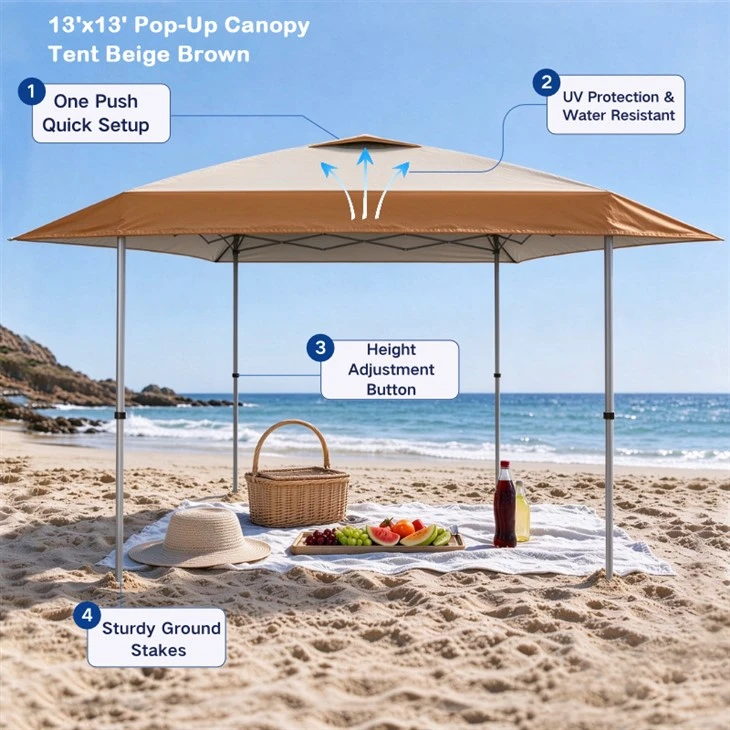
13' × 13' Pop-Up Canopy - Beige & Brown
A larger square canopy for outdoor gatherings and event use.
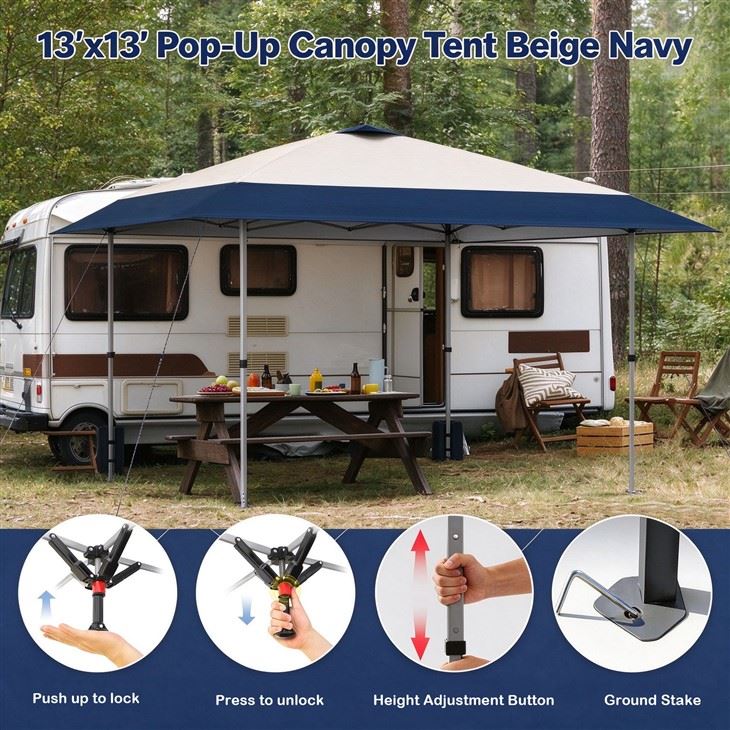
13' × 13' Pop-Up Canopy - Beige & Navy
A two-tone option in the larger 13' × 13' format.
10' × 10' Pop-Up Canopy - White
A versatile colourway for markets, backyards and outdoor activities.

10' × 10' Pop-Up Canopy - Black
A classic option that works across a wide range of outdoor uses.

10' × 10' Pop-Up Canopy - Blue
A blue canopy for outdoor events and recreational use.

These models are primarily produced to order. Product specifications, colour availability, customisation options and production lead times should be confirmed when discussing a project.
For venues where ground stakes are not permitted, buyers should also check whether suitable alternative ballast accessories can be supplied. Ground stakes should only be used where the installation site allows them.
Sourcing pop-up canopies for the Australian market involves more than comparing prices and dimensions. Local venue requirements, anchoring methods, fabric performance and frame construction all influence whether a product is suitable for its intended application.
Working with a manufacturer that understands product specifications and OEM requirements can make the sourcing process more efficient.
At Xiamen Xiesheng Outdoor Products Co., Ltd., we specialise in outdoor products, including pop-up canopies, camping tents, folding chairs, camping tables and collapsible wagons.
We support OEM customisation based on project requirements, including product specifications, fabric selection, colour options, logo printing and packaging.
Whether you are developing a new outdoor product line or looking for a manufacturing partner for wholesale orders, we welcome the opportunity to discuss your project.
Contact us to request our product catalogue, discuss your requirements and receive a quotation for your next canopy project.